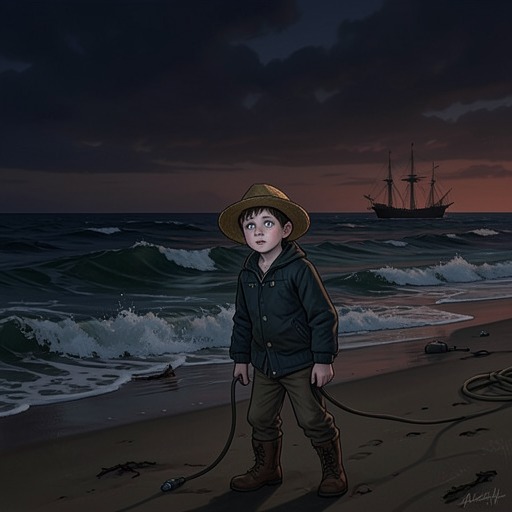
The hunt for Ralph, the island’s burning, and the rescue
Lord of the FliesThe hunt for Ralph, the island’s burning, and the rescue brings the boys’ collapse of shared order to its violent limit, then turns their destruction into the means of their deliverance. Jack's hunters organize a search to kill Ralph, drive him from cover with smoke, and set the island ablaze; the fire they use to flush him out is also the signal that brings a Royal Navy officer to the beach.
Background and stakes
At the start, Ralph had argued that the boys must keep a signal fire burning because a ship might pass and rescue them. The conch gave speakers a recognized turn, and even Jack had publicly accepted rules and responsibility for the lookout. But those arrangements had become increasingly fragile. When Simon tried to suggest that the beast might be something within the boys themselves, the assembly mocked and silenced him. Later, in a storm, Ralph and Piggy joined the hunters’ dance, where ritual and fear pulled even opponents into the crowd. The violence that followed Simon’s attempt to bring news of the dead man on the hill showed how thoroughly the imagined beast had taken hold.
The division became final at Castle Rock. When Piggy insisted that rules and rescue were better than hunting, Roger released a great rock from above. It killed Piggy and shattered the conch, destroying both the person most committed to reasoned argument and the object that had embodied the boys’ agreed authority. Jack then claimed leadership and attacked Ralph with a spear. Ralph fled into the forest as the tribe advanced. The later hunt is therefore not a contest between two functioning political systems: it is a pursuit conducted after the symbols and procedures of Ralph’s order have been violently broken.
The warning and the plan
Before the hunt began, Ralph secretly approached Sam and Eric. They were frightened and ashamed of their new loyalty to Jack's hunters. They told Ralph that they had been forced into the tribe, that Jack and Roger meant to kill him, and that the search would spread in a line across the island. The boys described how the hunters would advance from one end to the other, using a loud ululation as a signal. Their warning gave Ralph a clear picture of the danger: this would be an organized cordon, not simply a chance encounter in the forest.
Sam and Eric could not join him. They urged him to escape and warned that Roger was especially dangerous. Ralph asked what the hunters planned to do when they found him; they answered that the hunters would throw spears as they did at a pig. They also told him that the search was to begin the next day. Their divided position is stark: they try to help Ralph with information, but remain under the authority of the group that is preparing to kill him. When someone approached to check on them, Ralph had to leave without them.
Smoke turns pursuit into a fire
Ralph first tried to stay alive by moving through the forest and resisting the hunters’ attempts to close the line. At one point he thrust his spear through a gap in the thicket and wounded a pursuer. Voices argued nearby; then smoke began to seep through the branches, whitening the air and blotting out the patch of blue sky above him. A painted boy stood between Ralph and the open forest, coughing as he tried to see through the smoke. Ralph charged him with his spear and escaped into the undergrowth.
The smoke revealed the hunters’ method: they were setting the island on fire to force Ralph out of hiding. As Ralph ran, he heard the ululation sweep across the island and understood it as a signal keeping the advancing line together. He considered climbing a tree, breaking through the line, or hiding until the hunters passed, but every option carried danger. A hiding place might leave him trapped; a breakout might only bring the cordon around again. With the forest burning, even the landscape that had concealed him was becoming part of the pursuit.
He eventually crawled beneath a dense mat of bushes and creepers, where the darkness might hide him from anyone searching from above. The fire’s rumble grew nearer. A hunter stopped beside the thicket and peered into its obscurity. Ralph screamed, burst out, and struck with his sharpened stick before running again. Other hunters were closing in; the flames advanced alongside them, and the ululation rose behind him. His fear displaced thought and planning. He stumbled past burning shelters and ran toward the open beach, pursued by the hunters and the spreading fire at once.
Rescue on the beach
Ralph rolled onto the warm sand, crouching and raising an arm as if to ward off another attack. Instead, he looked up at a naval officer in a white-topped cap, with a revolver at his belt. A cutter had been hauled up on the beach, and a rating in its stern-sheets held a sub-machine gun. Behind Ralph, the hunters’ ululation faltered and died away. The force that had been closing around him stopped at the arrival of an adult authority backed by armed sailors and a boat.
The officer asked whether there were any adults with the boys. Ralph shook his head. A semicircle of painted boys stood nearby, silent and carrying sharp sticks. The officer remarked on the apparent contrast between the scene and ordinary boys’ games, then explained that the sailors had seen the smoke. That detail completes the reversal: Jack's hunters had made the fire to expose Ralph, but its smoke also functioned as the rescue signal the boys had ceased to maintain. The very tactic intended to end Ralph’s escape brought help within sight of the island.
Asked whether anyone had been killed, Ralph replied, “Only two. And they've gone.” The officer pressed him about the deaths, then looked over the boys as they emerged from the forest. Percival Wemys Madison tried to say his full name, but the familiar incantation had faded from his mind. Ralph, filthy and exhausted, could not even say how many boys there were. When the officer asked who was in charge, Ralph answered that he was. The officer said the sailors would take them away, while the burning island continued to shake with flame.
Reversal and significance
The rescue is not the restoration of the society the boys had lost. The officer sees painted children with weapons and a landscape on fire, but initially interprets the scene through the language of games and asks whether they have been having a war. His presence does stop the hunt, yet it does not undo what has happened: Piggy is dead, the conch is destroyed, Simon’s truth was not heard in time, and the boys have acknowledged two deaths. Ralph’s answer about those deaths is brief, while the officer’s expectation that British boys should have behaved better exposes the gulf between an adult’s assumptions and the violence the boys have enacted.
The signal fire also completes a grim pattern. Earlier, its intended purpose was to make rescue possible through vigilance and common effort. Now the boys have let that purpose collapse, and a blaze set to flush out one of their own supplies the smoke that brings the cutter. Rescue arrives not because order has been successfully preserved, but because the pursuit has become so destructive that it announces itself. Ralph reaches safety at the point when the island’s disorder has become impossible to hide.